Warning: Spoilers are ahead for Hollywood.
Netflix’s new series Hollywood gives Tinseltown a much-needed rewrite. And while it may be more fiction than fact, Ryan Murphy’s latest show is based in some reality — even if it is an altered one.
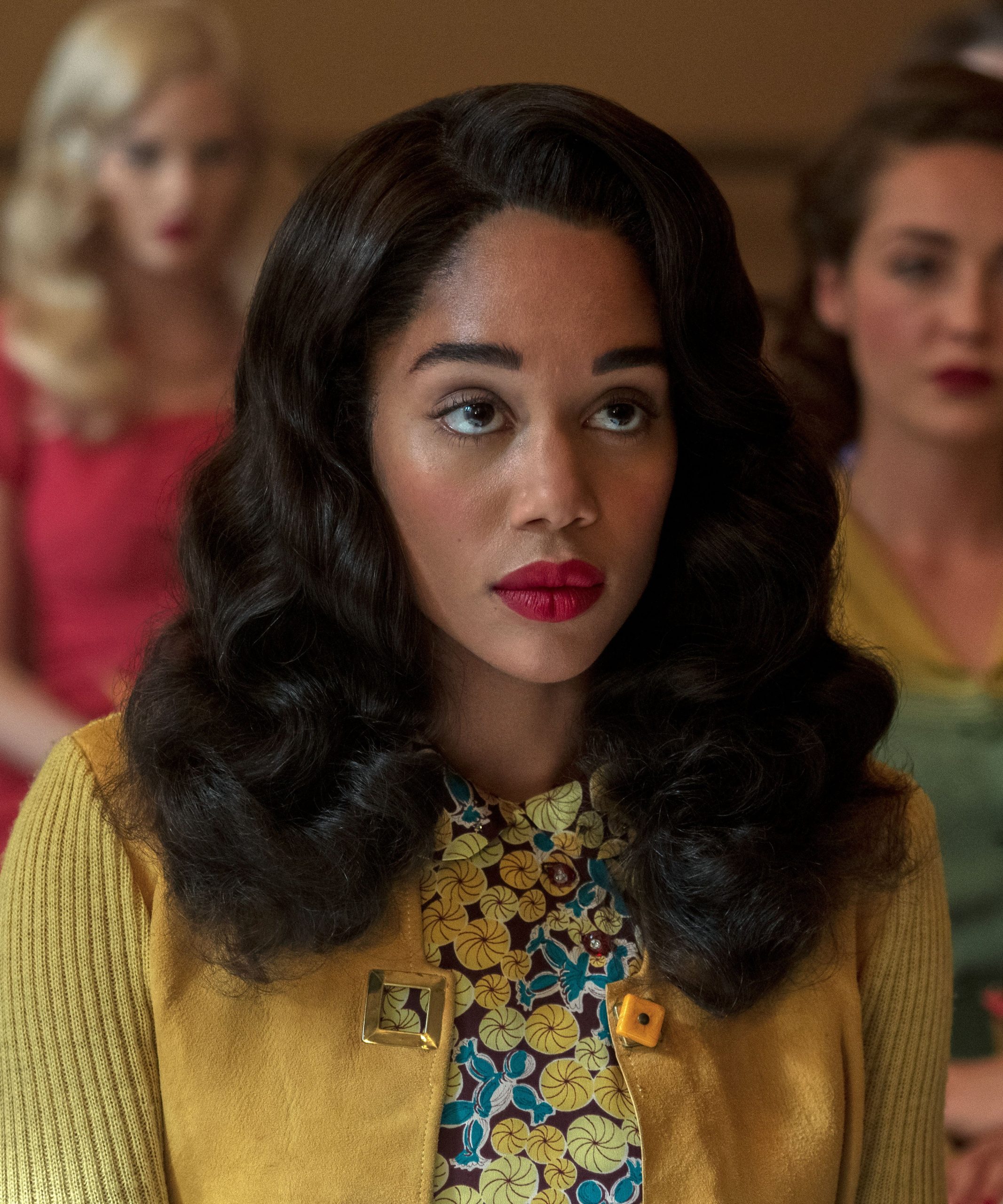
For instance, Hollywood’s leading lady Camille Washington, played by Laura Harrier, was inspired by Dorothy Dandridge, the first Black woman to get nominated for a Best Actress Oscar. “I drew from [Dandridge] and watched interviews with her and watched as many of her films as I could,” Harrier told Refinery29. “I wanted to pay homage to her with Camille.”
Harrier also wanted to give Camille the happy ending Dandridge, who died at the age of 42 of an apparent suicide, never got. “Unfortunately, I like to think Camille’s story goes on to be a bit more positive than Dorothy’s,” she said of Camille getting to realize her leading lady dreams. “Her career didn’t get to the places that I think it should have.”
Like Camille, Dandridge’s career started in the 1940s, but hers was in night clubs as a singer, often alongside her sisters. Dandridge would go on to become the first successful Black actress in Hollywood despite never being given the kind of opportunities the fictional Hollywood character was. “She really struggled in life,” Harrier said pointing to the racism of the era, that in many ways hasn’t gone away. Things are looking up, but Black women still struggle for leading roles in Hollywood.
For Dandridge, though, it wasn’t just systemic racism that kept her down, there were laws that kept her from playing the romantic lead in films. Anti-miscegenation laws, which enforced racial segregation in marriage and criminalized interracial relationships, existed in many American states until 1967. During the ’40s, Hollywood followed the Hays Code, which also refused to depict miscegenation, or couples of mixed race, onscreen. (In 1956, the Code removed the clause.) Since all of Hollywood’s leading men were white, it didn’t allow Dandridge much chance to play the romantic lead for the major studios.
Despite this, Dandridge’s career reached its peak in the 1950s. “I really loved Carmen Jones with her and Harry Belafonte,” Harrier said of the all-Black ensemble musical that Dandridge would call “a turning point in her career.” In an interview, Dandridge said she “never worked harder” on a film and that Carmen Jones “was the best time I ever had,” according to The New York Times.